
What Draws Us into Virtual Reality?

Uncover the captivating psychology behind gaming with Game Guides. Discover how escapism, achievement, socialization, and emotional connections draw millions into virtual worlds. Dive into the intrica...
How to Make Money with Virtual Coins: Tips for Smart Players

Learn how to earn real money with virtual coins! Discover game economy strategies, trading tips, and legal ways to convert coins into cash. From completing quests to using external platforms, find pra...
The Real Value Behind the Patsy Takemoto Mink Quarter

A technical overview of the 2024 American Women Quarters series featuring Patsy Mink. Includes mintage data, auction records, and market value analysis....
Design elements often act as silent witnesses to historical transitions.
James Monroe holds the fifth position in the Presidential Dollar program launched in 2007.
Federal legislation passed in 2005 mandated the chronological release of these assets.
Public circulation of the James Monroe dollar coin began on February 14, 2008.
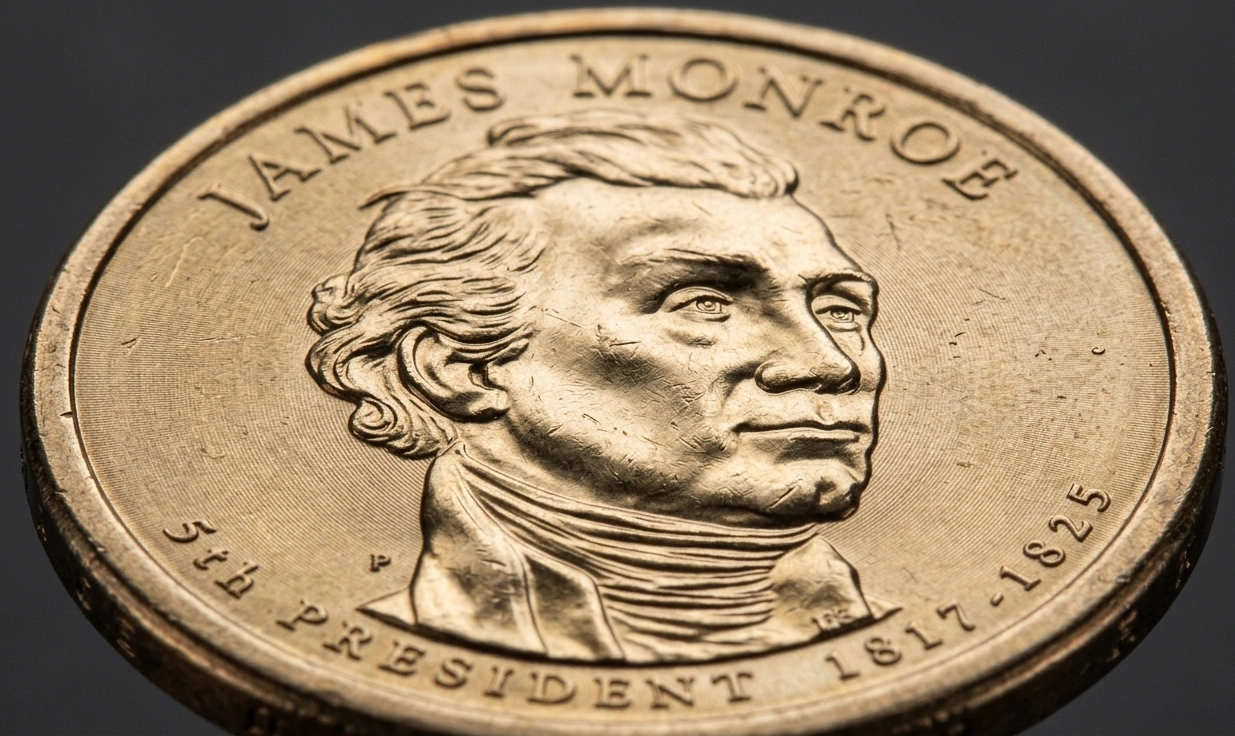
Financial institutions recognize this piece as legal tender at face value.
Physical Property | Specification Value |
Total Weight | 8.1 grams |
Outer Coating | Manganese-Brass Alloy |
Core Metal | Pure Copper |
Estimated Service Life | 30 years |
Edge Thickness | 2 millimeters |
Production occurs primarily at the Philadelphia and Denver facilities.
Mint marks stamped on the edge identify the specific origin.
Total output in 2008 reflected a significant downward trend in demand.
Public interest in dollar coins decreased during this specific fiscal year.
Output breakdown by mint facility:
Philadelphia (P) — 64,260,000 units
Denver (D) — 60,200,000 units
San Francisco (S) — 3,083,940 units
Total circulation strike → 124,460,000 units
Total proof strike for collectors → 3,083,940 units
Production dropped by 64 percent compared to the initial George Washington release.
Obverse imagery originates from historical portraits dating to the early 1800s.
Joseph Menna executed the portrait engraving for the front side.
Don Everhart finalized the Statue of Liberty design for the reverse.
Text placement on the Monroe coin follows the 2008 redesign protocols.
Factors driving edge-lettering modifications:
Moving "IN GOD WE TRUST" to the obverse → Congressional mandate
Clearing space on the rim → Improving date visibility
Edge inscriptions are applied by specialized machinery following the main strike.
The 2026 numismatic market shows sustained interest in high-grade specimens.
Standard examples found in change retain only their $1 face value.
Investment-grade status requires a minimum rating of MS67.
Preservation Grade | 2026 Market Price |
MS66 Grade | $12 |
MS67 Grade | $55 |
MS68 Grade | $950 |
PR70 DCAM (Proof) | $165 |
Record-breaking sales for an MS68 specimen reached $2,820 at auction.
Price performance trends:
Annual appreciation for MS68 → 6 percent
Value decline for MS66 due to high supply → 2 percent
Rare error premium growth → 10 percent per year
Most coins lose 90 percent of their secondary value upon receiving a single scratch.
Mechanical failures during striking create high-value sub-types.
Irregularities in the planchet feeding process result in missing inscriptions.
Confirmed error types for the Monroe dollar:
Missing Edge Lettering — Smooth rim
Double Strike — 5-10 percent image displacement
Weak Strike — Worn die causing facial blur
Die Clashes — Impressions of the opposite side on the field
A smooth-edge Monroe coin currently trades for $80 in 2026.
Obtaining certification from Professional Coin Grading Service increases the liquidity of error coins.
Missing edge text is considered a rare occurrence for the 2008 series.
Assigning a formal grade requires between 30 and 60 days, or 1 min with the free coin identifier app.
Specialists utilize the Sheldon Scale ranging from 1 to 70.
Grading criteria for the Monroe dollar:
Luster — Presence of original satin sheen
Strike — Detail clarity on the hair and ear
Surfaces — Absence of microscopic marks from other coins
Centering — Equal rim width around the circumference
Certification services in 2026 cost approximately $25 per coin.
Reselling a certified coin happens four times faster than uncertified ones.
The Secretary of the Treasury approves every coin design.
The Commission of Fine Arts provides recommendations for sketches.
Changing the metal mixture requires Senate approval.
Counterfeiting presidential dollars is a federal crime.
Counterfeit instances for the Monroe coin are almost non-existent in 2026.
Low face value makes forgery economically illogical.
Weight variances are permitted during mass production.
Official tolerance allows for a 0.3-gram deviation in either direction.
Mass indicators for large batches:
100 coins → 810 grams
1000 coins → 8.1 kilograms
Standard bank box — 2000 coins
Shipping boxes weigh approximately 16.5 kilograms when full.
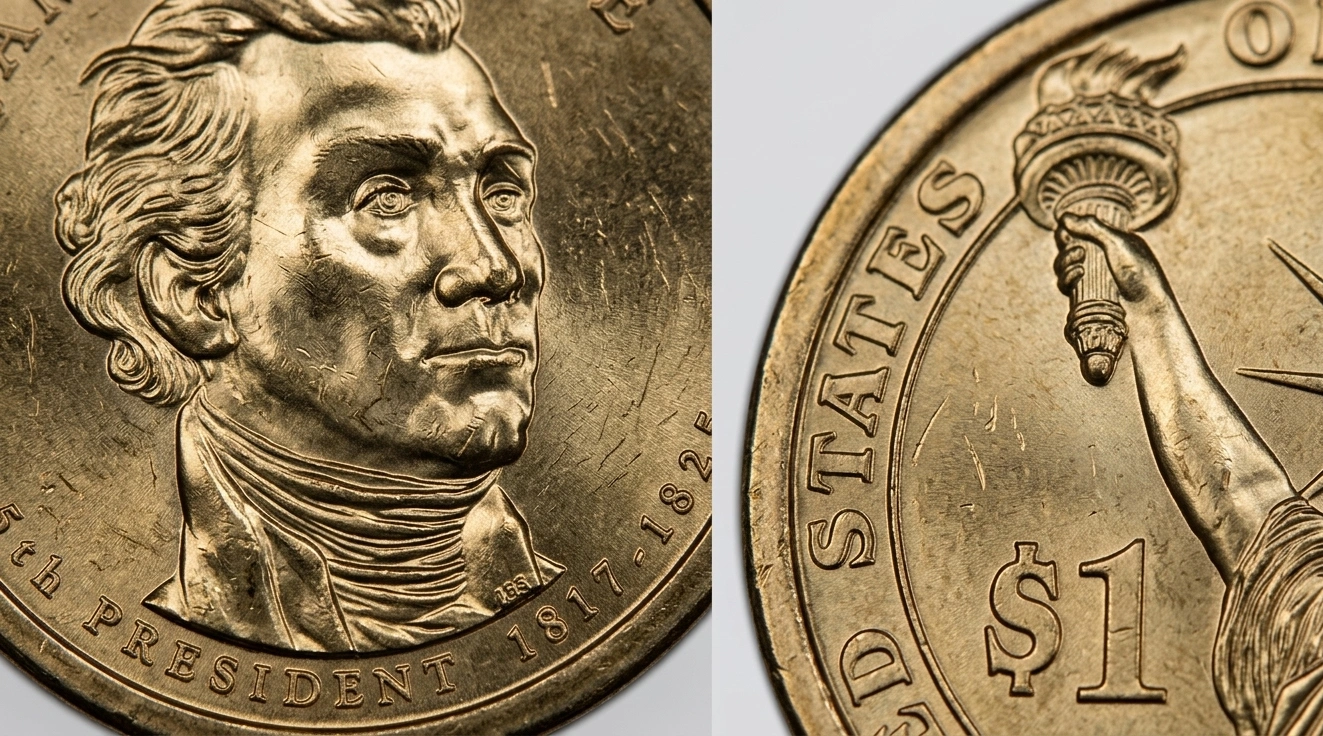
Monroe coins are frequently used in automated vending machines.
Transit payment systems accept these discs without technical errors.
Durability remains the primary advantage over paper notes.
Cycle comparisons:
Paper dollar — 18 months
Monroe coin — 360 months
Budget savings from using coins reach hundreds of millions of dollars.
Rim text is applied after the primary relief is formed.
Schuler brand machinery performs this specific task.
Operating speeds reach 800 coins per minute.
The inscription includes:
Year of mintage — 2008
Mint mark — P, D, or S
Latin motto — E PLURIBUS UNUM
Thirteen stars — Representing the original states
Segmented ring malfunctions create unique variations in letter placement.
The free coin value lookup involves three fundamental parameters.
Phase one requires precise weighing on electronic scales.
Phase two involves measuring the diameter using calipers.
Phase three requires checking the rim for all text elements.
Signs of a fake:
Blurred letter edges on the rim
Paint coating instead of metal alloy
Weight below 7,8 grams
Authentic Monroe coins produce a distinct ringing sound when dropped on hard surfaces.
Major auction houses record sales on a quarterly basis.
Heritage Auctions completed 12 Monroe coin transactions in 2025.
Average lot duration during bidding is 5 minutes.
Recent auction results:
MS68 (NGC certified) — Sold for $910
MS68 (PCGS certified) — Sold for $1,050
Price differences between grading companies average 15 percent.
Buyers demonstrate a preference for PCGS holders.
What Draws Us into Virtual Reality?
Uncover the captivating psychology behind gaming with Game Guides. Discover how escapism, achievement, socialization, and emotional connections draw millions into virtual worlds. Dive into the intrica...
How to Make Money with Virtual Coins: Tips for Smart Players
Learn how to earn real money with virtual coins! Discover game economy strategies, trading tips, and legal ways to convert coins into cash. From completing quests to using external platforms, find pra...
The Real Value Behind the Patsy Takemoto Mink Quarter
A technical overview of the 2024 American Women Quarters series featuring Patsy Mink. Includes mintage data, auction records, and market value analysis....